AQSim · Digital Dynamic Scale Loop (DDSL) & Production Tubing Simulator (PTS)
Simulate the scale-loop test for any well, in minutes.
Thermodynamic tools predict whether scale will form. AQSim goes further — it simulates the Dynamic Scale Loop experiment itself. Put in brine chemistry, tube geometry, temperature, and inhibitor dosing; get back the differential-pressure (dP) curve, deposition profile, and inhibitor performance the test is run to produce.
Works alongside your physical DSL program — evaluate a candidate before you commit a run to it.
Why it matters
Most wells never get tested.
The physical experiment that predicts scaling — a Dynamic Scale Loop study — takes about a day per run, and of the world's millions of wells, only a fraction will ever get one. AQSim runs the same experiment in software in under five minutes, at $5 per simulation, so scaling can be evaluated on the wells that would never justify a physical run.
The value isn't only running today's tests faster — it's evaluating the wells the rig never reaches.
What it does
The whole run, not a single number.
AQSim models what happens inside the coil across the length of the run — not just a scaling index. And because the simulator isn't bound by rig time, you run the real, un-spiked brine to blockage — not a spiked proxy — and build a treatment program for early, mid, and late life instead of extrapolating from a handful of experiments.
Differential-pressure curve
Watch dP build over the run and read the induction time before the tube begins to block — the pressure side of the result.
Deposition profile
See how much scale forms and where it lays down along the tube as the run progresses — the deposition side of the result.
Treatment comparison
Overlay inhibitor candidates and dosing rates on one chart and compare how each holds the tube open — predicted performance to inform your own selection.
Built-in thermodynamics
Screen a mixture before you commit a run to it — saturation ratios and induction times, computed in the platform or entered from the tools you already own.
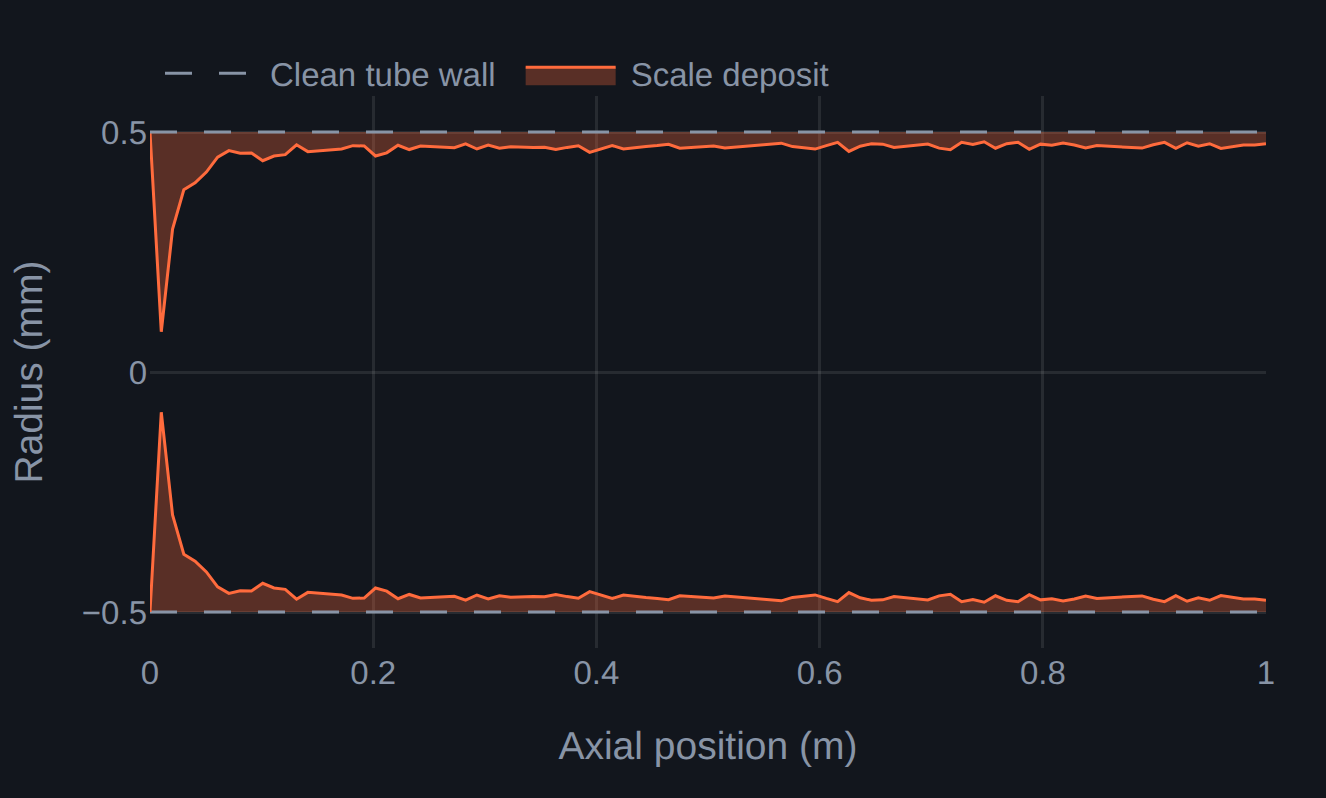
Solver telemetry
- Runtime (s)
- 42.76
- Total iterations
- 125,913
- Time to 1 psi (s)
- 1,637
- Final dt (s)
- 0.001153
Actual output from a run on the platform: 42.76 seconds of wall-clock compute. The other figures describe the simulated run — dP crossed 1 psi at 1,637 seconds of tube time — and the timestep adapts as the tube blocks, evidence of a real transient solver, not a correlation.
untreated CaCO₃ example run live platform output
Where it fits
Simulate the experiment — don't just predict the risk.
Simulate, not just predict
Thermodynamic tools like OLI ScaleChem™ are right about what they answer: whether a brine can scale. AQSim answers the next question: when the tube blocks, and which inhibitor holds it open. Bring your OLI ScaleChem output and the simulation runs on your numbers; AQSim's own thermodynamics covers the rest, so the tools you already own become more valuable.
Alongside your physical program
Use it to prioritize and de-risk before you run a loop. It complements bench testing — it doesn't replace your lab.
Private to your account
Your brine chemistry, your results, and the parameters fitted to your products stay isolated to your account by default — your data shapes nobody else's model unless you opt in, by separate agreement. Build your own inhibitor and blend library, and we calibrate the simulator against your own historical DSL experiments — every run you have already paid for sharpens the model fitted to your system.
The science
Built by a scale scientist.
AJ Gerbino, PhD
AQSim's model is grounded in decades of produced-water and scale-chemistry research — a widely published body of work, including peer-reviewed SPE studies of scale-inhibitor performance. AQSim's job is to put that rigor in a browser: the science you'd expect from a specialist, on inputs a production chemist can set in a minute.
The model is mechanistic — chemistry, kinetics, and mass transfer — and calibrated to your rig and your chemistry. That calibration is what lets a simulation reach past the points you've measured.
On the roadmap
What's next.
More scaling minerals
Calcium carbonate today, with the field's other common scales on the way.
From the tube to the pipe
The Production Tubing Simulator (PTS) extends the same approach from the lab loop toward production piping, modeling where scale builds in the field, not just in the coil.
The simulator runs today — we offer it as a guided study while the self-serve product is in development.
The platform
Your chemistry, in a system you can defend.
AQSim is cloud-hosted — nothing to install. The questions that come up in a procurement review have concrete answers: who can get in, what changed and when, and what you can put in front of your boss a year from now.
A database of your own
Your brine chemistry, your cases, and your run history live in a database of your own — one per customer, not one pool shared between them.
Invitation-only
There is no public sign-up. Accounts are opened by invitation, so access to your work is always deliberate.
A report you can file
Every run and comparison exports as a dated PDF — the inputs, the curves, and the key results, across as many inhibitors and concentrations as you care to compare — so a number you quoted in March is still defensible in September. Every chart also copies straight into a document or a spreadsheet, as an image or as its plotted numbers, and the pressure curve and tube geometry draw as the run computes rather than after it.
An audited calibration history
Every staff edit to a parameter fitted to your products is recorded — the old value, the new one, who made it, when, and why — and we can produce that history on request.
Pricing
Prepaid simulation credits.
No seat licence — one credit per simulation run, blank or treated, including the untreated reference a comparison or a Both (DSL) run submits. Seat-licensed tools in this category run to five figures a year.
- Starter $500 100 simulation credits
- Standard $2,375 500 simulation credits
- Enterprise $4,500 1,000 simulation credits
Prices in USD. Credits never expire. Purchases are non-refundable — but a run you stop before it starts, or that fails on our side, gets its credit back automatically. Payments are processed securely by Stripe; we never see or store your card details.
Early access
See it run on your own chemistry.
AQSim is in active development, and we're onboarding early users across the industry — from chemical suppliers and testing labs to the operators who live with scale. Request access and we'll arrange a demo on your own brine chemistry.